
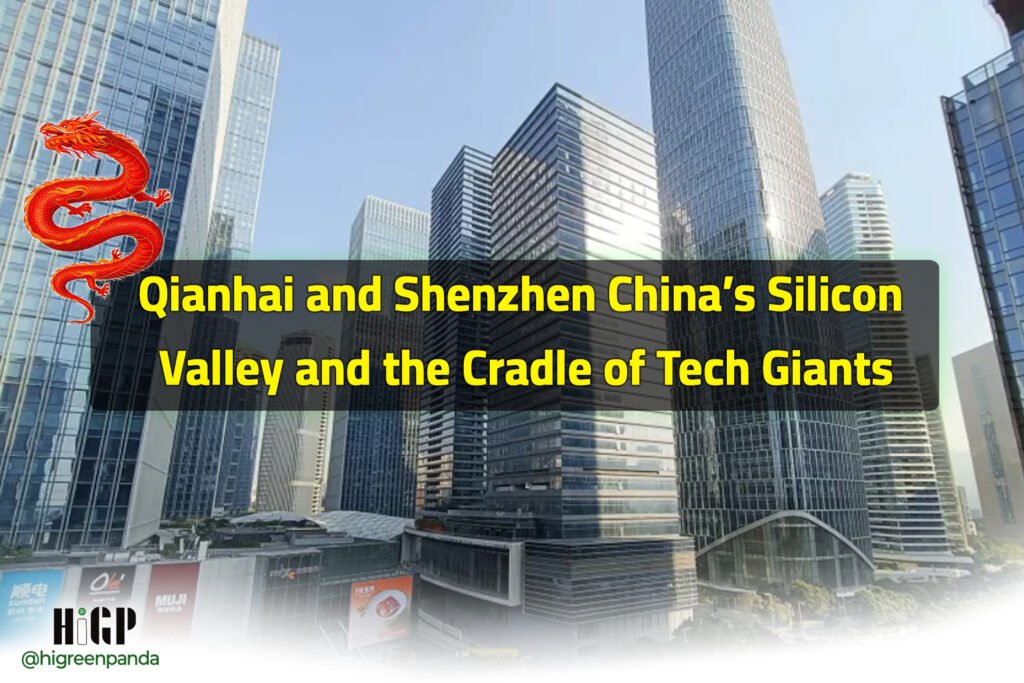
Qinhai and Shenzhen are China’s Silicon Valley and the birthplace of major companies.
Shenzhen, Southern China – Guangdong Province in southern China, long familiar to traders from the Arab world, Asia, Africa, and Europe, holds a special economic importance. Beyond Guangzhou—home to China’s famed trade fair since 1957—the province boasts several rising industrial hubs and anchors the Greater Bay Area (GBA), which also includes Hong Kong and Macao.Qianhai and Shenzhen: China’s Silicon Valley and the Cradle of Tech Giants Among the most dynamic of these are Shenzhen and Qianhai, the closest mainland neighbors of Hong Kong and Macao. Together, they are part of an integrated cluster of 11 interconnected cities that form the Greater Bay Area, now a major engine of China’s economic modernization. In December, Hong Kong hosted for the second year a high-level conference on GBA development, bringing together over a thousand policymakers, investors, and entrepreneurs from across China and abroad. The event underscored the central role of geography in China’s economic planning—each region is tasked with cultivating distinctive strengths in manufacturing, exports, and innovation as the nation competes with global economic powers. The Nine Sister Cities Launched in 2017, China’s Greater Bay Area strategy envisions Hong Kong as a “window” and “catalyst” for its nine mainland sister cities—each offering unique advantages: Guangzhou: The provincial capital and China’s commercial hub, home to 80 universities, one million students, and over 100,000 tech-focused enterprises. Zhaoqing: Known for its cultural heritage, history, and tourism appeal. Huizhou: A port city with strengths in petrochemicals and IT manufacturing; ExxonMobil has invested nearly USD 19 billion there. Rich in resources and home to clean air, abundant forests, and vibrant agriculture. Foshan: Famous for furniture, ceramics, home appliances, martial arts, and traditional Chinese medicine. Dongguan: A global industrial hub producing around 60,000 product types across 40 sectors. It supplies 90% of electronic components for devices like smartphones, hosting 5,700 manufacturers tightly linked with Shenzhen and Hong Kong. Zhongshan: A vital transport hub and experimental industrial zone with shipbuilding, textiles, lighting, pharmaceuticals, and heavy industries. Jiangmen: Known as a hometown for overseas Chinese, attracting returning migrants. Zhuhai: Site of China’s airshows and defense exhibitions; directly linked to Hong Kong and Macao via the 55 km Hong Kong–Zhuhai–Macao Bridge, the world’s longest sea crossing, used by 27 million people in 2024 alone. Shenzhen: The “Silicon Valley of China,” birthplace of some of the nation’s most prominent tech firms. Qianhai’s Appeal Qianhai, a special district within Shenzhen, has attracted thousands of Hong Kong entrepreneurs, particularly young innovators, thanks to tax incentives and business-friendly policies. Established as the Qianhai–Shenzhen–Hong Kong Modern Service Industry Cooperation Zone, it promotes financial, trade, and logistics integration, while harmonizing legal, commercial, and intellectual property frameworks between Hong Kong and the mainland. Shenzhen: China’s Silicon Valley Shenzhen has become a global innovation hub, home to China’s most iconic technology companies: DJI: The world’s largest drone maker, pioneering aerial imaging and expanding into smart aviation systems. The drone economy is projected to reach USD 136 billion in the coming years. BYD: Founded 30 years ago, it has grown into the world’s largest electric vehicle producer, surpassing Tesla, with nearly 30 factories worldwide and an industrial city targeting USD 27.6 billion in annual output. Tencent: A tech giant serving over a billion users with apps for social media, digital payments, entertainment, and gaming—making it one of the largest content and gaming companies globally. Huawei: Established in 1987, now employing 207,000 people in 170 countries and serving 3 billion people with telecommunications and ICT solutions. Insta360: A rising star in portable action and panoramic cameras, dominating more than half the global market for personal 360° cameras, valued at over USD 276 million. Economic Powerhouse of the South The Greater Bay Area is among the wealthiest regions in southern China, with a combined GDP of USD 2 trillion in 2023, nearly one-ninth of China’s national output—double its 2013 level. Its ports handled 85+ million containers annually, making it one of the world’s most important trade and shipping hubs. Covering 56,000 km² with a population of over 86 million, the GBA is projected to rival other global bay areas such as Tokyo, San Francisco, and New York by 2035. The region’s rise is closely linked with the Belt and Road Initiative (BRI), launched 11 years ago. Enhancing the role of Shenzhen, Qianhai, and their sister cities strengthens China’s global presence under the BRI framework—while foreign partnerships developed through the initiative bring more investment, trade, and opportunities into the GBA.