Importing from China
Import Methods from China: Direct Buying or an Intermediary?
Direct buying, a sourcing agent or a full import manager: each import method from China trades cost against risk and your time. This guide shows how each works and which fits your order.
作者:萨米·哈吉里阅读约需 9 分钟
You have found a product that sells at home and a price in China that leaves a margin. The next question is how to buy it: straight from the factory, through a trading company, or with someone in China handling the work for you. The import methods from China differ in what you pay, how much risk you carry and how many hours you spend on calls and emails. By the end of this guide you will know how each method works, what it costs and which one suits your first or next order.
The four ways Gulf importers buy from China
Most importers use one of four routes. They are not exclusive; many traders start with one and move to another as their volume grows.
Buying direct from a factory
You find the manufacturer, negotiate with its sales team, pay it directly and arrange your own inspection and freight. This gives you the lowest unit price and full control over specifications. It also puts every risk on you: a wrong supplier, a poor batch or a missed shipping date is your problem to solve from thousands of kilometres away.
Buying through a trading company
Many sellers on Alibaba and Made-in-China are trading companies, not factories. They buy from several factories and resell. Their prices are usually a few percent higher, but they often accept smaller orders, speak better English and can combine different products in one shipment. The drawback is that you rarely know which factory makes your goods, which makes quality control harder.
Using a sourcing agent
A sourcing agent is based in China and works for you, not for the seller. The agent finds and vets suppliers, negotiates, follows production and often arranges inspection. Fees are commonly a percentage of order value, often somewhere between 3% and 10%, or a fixed fee per project. Small orders tend to attract the higher percentage.
Full import management
Here one company handles the chain from supplier search to delivery at your warehouse: sourcing, contracts, quality inspection, export documents, freight and sometimes customs clearance at destination. You pay more in fees but deal with one party and one invoice. This suits importers who run another business, buy several product lines, or cannot travel to China.
Direct importing or an intermediary: the real trade-offs
The choice is not only about the commission. It is about who carries the risk and who spends the time.
What direct importing gives you and costs you
- Lower cost: no commission or service fee on top of the factory price.
- Direct relationship: you build your own contacts, which pays off on repeat orders.
- Higher risk: fraud, fake certificates, or goods that do not match the sample are harder to spot and harder to recover from.
- More time: expect weeks of research, messages across a 4 to 5 hour time difference with the Gulf, and follow-up during production.
- Language and contracts: you need a clear written specification and, ideally, a contract with a Chinese-language version.
What an intermediary gives you and costs you
- Time saved: someone on the ground visits factories, chases production and handles documents.
- Risk reduced, not removed: a good agent checks business licences and catches problems before shipment, but no one can promise a perfect batch.
- Extra cost: fees, and sometimes hidden margins if the agent also takes commission from the factory.
- Less direct contact: you may not own the supplier relationship unless your agreement says so.
A simple rule: the smaller your order and the less experience you have, the more an intermediary is worth. The larger and more repetitive your orders, the more sense it makes to deal direct, with inspection bought as a separate service.
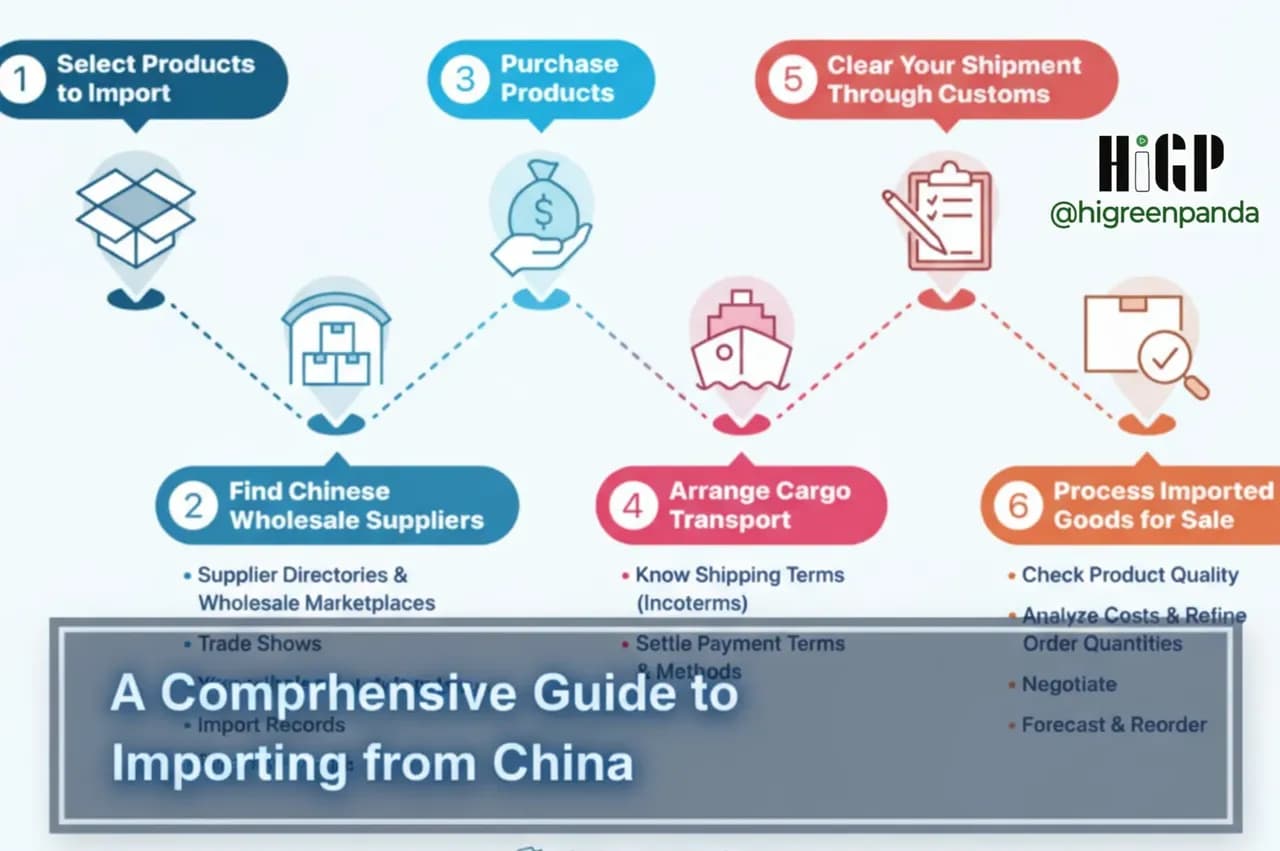
How to import from China step by step
Whichever method you choose, the steps are the same. What changes is who does each one. For a fuller walk-through of a first order, see our step-by-step guide for beginners.
- Choose the product and check demand. Study your local market: shop prices, competitors, seasonality. Confirm the product is allowed into your country and what certificates it needs, for example SASO or SABER registration for many goods entering Saudi Arabia.
- Search for suppliers. Use B2B platforms such as Alibaba, Made-in-China and Global Sources. Filter for verified suppliers and years in business, and read buyer reviews.
- Contact at least three to five suppliers. Ask for unit price, minimum order quantity (MOQ), payment terms, production time and the Incoterm they quote (EXW, FOB or CIF).
- Verify the supplier. Ask for the business licence and check that the company name and scope match. Ask whether they are the factory or a trading company.
- Order samples. Pay for samples and courier costs if needed; they usually take 7 to 15 days to arrive in the Gulf by express. Test them as your customers would.
- Negotiate and put it in writing. Agree price, specification, packaging, labelling, delivery date and penalties. A common payment structure is 30% deposit and 70% before shipment.
- Inspect before you pay the balance. Book a pre-shipment inspection so you pay the 70% only once the goods pass.
- Choose the shipping method. Sea freight is the default for volume: FCL in a 20ft or 40ft container, or LCL if you have only a few cubic metres. Air or express suits samples and urgent, light goods.
- Clear customs at home. Prepare the commercial invoice, packing list, bill of lading and certificate of origin. Most goods entering GCC states pay 5% duty on the CIF value, but some items carry higher rates, so confirm your HS code with a customs broker.
Where to find suppliers: platforms and markets
The platform you use shapes the method you end up with.
- Alibaba: the largest B2B platform, mixing factories and trading companies. Trade Assurance gives some payment protection if you pay through the platform.
- AliExpress: a retail platform for small quantities at higher unit prices. Useful for testing a product, not for stocking a shop.
- Made-in-China and Global Sources: B2B platforms with a strong base of manufacturers, especially for electronics, machinery and hardware.
- 1688: the domestic Chinese wholesale platform, often with lower prices but in Chinese only and without export support. Most foreign buyers use it through an agent.
- Trade fairs and wholesale markets: the Canton Fair in Guangzhou and the Yiwu market let you meet suppliers in person and see products before ordering.
Industries cluster by city, so knowing where your product is made narrows the search. Our guide to the top industrial cities in China shows which regions lead in electronics, furniture, textiles and more.
What each method costs in practice
Compare the landed cost, not the unit price. Landed cost is the factory price plus freight, insurance, duty, clearance, local delivery and any service fees.
- Direct: factory price, plus your own inspection (a pre-shipment inspection often costs around USD 250 to 350 per person-day), plus freight and clearance.
- Trading company: a slightly higher unit price, often with lower MOQ and consolidation included.
- Sourcing agent: factory price plus the agent's fee; ask whether inspection and consolidation are included or billed separately.
- Full import management: a larger fee in exchange for one point of contact; ask for a written breakdown so you can compare it with doing each step yourself.
Freight moves more than people expect. A 40ft container from southern China to Jebel Ali or Jeddah can cost several times more in a peak season than in a quiet month, so ask for a current quote before you price your goods. For ways to cut the total, read strategies to reduce import costs.
How to choose the right method for your order
Answer these questions honestly before you decide.
- Is this your first order from China, or have you imported this product before?
- Is the order value under about USD 10,000, where a fixed agent fee weighs heavily, or much larger?
- Does the product need certification, custom packaging or your own brand?
- Can you or a trusted person visit the factory, or will you rely only on photos and video calls?
- Do you have time each week to follow production, or do you run another business?
- Will you buy several products from different suppliers that need to ship together?
If most answers point to little time, little experience or several suppliers, an intermediary is usually the better value. If you have a tested product, a known factory and repeat orders, direct buying with independent inspection is often enough.
Common mistakes with each import method
- Choosing on unit price alone. The lowest quote often hides thinner materials, a trading company markup or a longer lead time.
- Paying 100% up front to a new supplier. Keep a balance until the goods pass inspection.
- Using an agent without a written agreement. Set out the fee, what it covers, who owns the supplier contacts and whether the agent may take factory commission.
- Skipping inspection because the samples were good. Samples are made with care; mass production is not always. Read why quality inspection before shipment matters.
- Forgetting destination rules. Goods held at a Gulf port for missing certificates cost storage fees every day.
- Treating an intermediary as a guarantee. An agent reduces risk; you still need clear specifications and your own checks. See our risk management strategies for the full picture.
What to do this week
Write one page describing your product: materials, size, colours, packaging, target price and quantity. Send it to three to five suppliers on a B2B platform and ask each whether they are a factory or a trading company. At the same time, ask a customs broker in your country for the HS code, duty rate and certificates your product needs. With those answers you can compare direct buying against an intermediary on real numbers. If you want someone in China to find and check suppliers for you, HiGreenPanda offers product sourcing from Shenzhen and Shanghai.
本文解答的问题
What is the best way to import from China for a beginner?
For a first order, a sourcing agent or full import management usually costs less overall than learning from expensive mistakes. The agent vets suppliers, follows production and arranges inspection. Once you have a tested product and a reliable factory, you can move to direct buying.
Is it better to buy from a factory or a trading company in China?
A factory gives a lower unit price and more control over specifications. A trading company often accepts smaller orders and can combine several products in one shipment, but usually charges a few percent more and may not tell you which factory makes your goods. Ask every supplier which one they are and check the business licence.
How much does a sourcing agent in China charge?
Fees are commonly a percentage of order value, often between 3% and 10%, or a fixed fee per project. Smaller orders tend to pay the higher percentage. Ask what the fee covers, whether inspection is included, and whether the agent takes any commission from factories.
Can I import from China without an agent?
Yes. Many importers buy direct through Alibaba, Made-in-China or Global Sources, or at trade fairs. You then need to verify suppliers yourself, write a clear specification, book an independent pre-shipment inspection and arrange freight and customs clearance.
What is the difference between Alibaba and AliExpress for importing?
Alibaba is a B2B platform for bulk orders, with minimum order quantities and negotiated prices. AliExpress sells small quantities at retail-style prices. AliExpress is useful for testing a product; for stock you intend to resell, Alibaba or a direct supplier is usually the better route.
HiGreen Panda Marketing