Importing from China
Importing Cars from China: What State Support Means for You
Why Chinese cars reach the Gulf at such low prices, what a decade of state support did to the market, and how to tell a real exporter from an opportunist before you transfer any money.
作者:萨米·哈吉里阅读约需 11 分钟

Offers of Chinese cars reach you at prices far below what you expected, and you ask yourself whether this is a real opportunity or a trap. The answer to any question about importing cars from China starts with understanding how the Chinese car industry was built, and why it now exports in such volumes and at such prices. In this guide you will learn how state support affected the market, the opportunities and risks it created for importers, and how to tell a professional company from an opportunist before you transfer anything.
How did China go from car importer to global competitor?
China is no longer just the world's workshop. It has become a force shaping the future of whole industries, and cars lead the list. Between 2009 and 2022 the Chinese government ran a broad financial and strategic support programme for electric and hybrid vehicles, including direct subsidies on the purchase price. After that, the exemption from vehicle purchase tax on electric cars continued, with the benefit reduced step by step. The aim was not only to strengthen local manufacturing but to turn the country from a car importer into an exporter present in every market.
The result shows in the figures. In 2023 China became the world's largest car exporter, with exports of almost 5 million vehicles according to the China Association of Automobile Manufacturers (CAAM). Electric vehicles were also one of the priority sectors in the Made in China 2025 plan.
What were the goals of this strategy?
The support was neither random nor a temporary incentive. It was a long-term investment with four goals:
- Encourage local manufacturing: build a complete national industrial base, from batteries to parts, that reduces reliance on imports.
- Speed up the shift to electric: push innovation in electric and hybrid vehicles, a field where Chinese companies were not as far behind competitors as they had been with petrol engines.
- Create a competitive environment: drive local competition to produce better and more efficient cars, which fed through to quality and prices.
- Expand globally: prepare the industry to enter foreign markets and export in large volumes.
What did state support do to the Chinese market?
The policies produced a real industrial boom, but they also created problems that affect you directly as an importer.
A surge in manufacturers, then a shake-out
At the peak of the subsidies, hundreds of new companies appeared; circulating estimates put the number at around 500. Not all of them were real businesses. Many were set up to collect subsidy money without a working business model. As support was cut back, the market went through a harsh shake-out: around 400 companies disappeared, fewer than 100 remain active, and most production is now concentrated in a smaller number of large groups.
Production capacity above domestic demand
China produced about 30 million vehicles in 2023, but factory capacity is much larger than that and domestic demand cannot absorb all of it. This surplus capacity, together with a fierce price war between manufacturers, has pushed factories hard into foreign markets, including the Gulf.
The move to electric added pressure
In large cities such as Shanghai, number plates for petrol cars are auctioned, at prices that have reached around CNY 90,000 to 100,000 per plate, while qualifying electric cars received plates free of charge. Many buyers moved away from petrol cars, stock built up at factories and dealers, and export became the main outlet for clearing it. That is why you now see many offers of new Chinese petrol cars at low prices in Gulf markets.
What opportunities did this create for Gulf importers?
- Fierce competition and lower prices: the number of manufacturers and the price war have cut factory prices sharply, which gives you more room to negotiate.
- Government encouragement of exports: to deal with the surplus, the government encouraged exporting stock, opening access to large volumes at competitive prices.
- Export VAT rebate: the exporter recovers the VAT paid. The rate on cars is now 13%, down from 17% before the cuts of 2018 and 2019. Some companies therefore sell at cost or below and rely on the rebate as their profit.
- Wider choice of models: electric, hybrid and petrol cars in every class, with infotainment and driver-assistance features that used to be limited to higher trims.
A price that depends on the tax rebate also means the exporter's margin is thin. Any problem with its paperwork or legal status can stop the rebate, and it may then try to recover the loss from you through delays or changed terms.
Electric, hybrid or petrol: what should you import for the Gulf?
Chinese support focused on electric vehicles, but your market decides. A Chinese electric car is often the strongest on technology and the most competitive on price, but selling it in your country depends on how widespread charging stations are, on buyers' confidence in battery performance in summers above 45°C, and on resale value. A plug-in hybrid is a sensible middle ground for buyers who drive long distances between cities. Chinese petrol cars benefit from the surplus stock described above, so they arrive at strong prices and suit a market used to them.
Ask the factory about the battery cooling system, the written battery warranty in years and kilometres, and the availability of cells and parts outside China. For a deeper look at the battery industry behind these cars, see investment in China's green energy sector.
Which risks do you need to plan for?
Shell companies
Many companies set up during the subsidy years lack experience and infrastructure. Their aim is quick profit, not building a brand, and dealing with them is risky.
Wide differences in quality
Not all Chinese cars are equal. Some manufacturers produce high-quality vehicles; others produce poor ones built only to sell. Inspect every shipment and do not rely on the model name alone. What to check is covered in quality inspection in China before shipment.
Vanishing brands and spare parts
Companies that went bankrupt or left the market left importers and customers without technical support or spare parts. In the Gulf, where buyers expect a warranty and after-sales service for years, this is the most serious problem you can face after the sale.
Requirements in the destination country
The car must meet Gulf specifications and your national standards authority's requirements, such as the SABER platform in Saudi Arabia, and its air conditioning and battery must cope with high heat. Check these requirements before you sign, not when the container reaches port. Follow China's own export rules too: China has recently tightened controls on electric vehicle exports, so ask the exporter for proof that it is authorised to export under the current rules.
Work out the landed cost, not the factory price
An attractive factory price can lose its appeal once you add the rest: inland transport to the port, sea freight and insurance, customs duty in your country (5% on most cars under the GCC common tariff), local VAT (5% in the UAE and 15% in Saudi Arabia), plus conformity, registration and clearance fees. Ask your customs broker to confirm the rates against the car's exact tariff code, as some categories are treated differently. Compare the final figure with the price of an equivalent car at the local dealer before you judge the deal. Underestimating landed cost is one of the common mistakes when importing from China.
How do you tell a professional exporter from an opportunist?
This is where a successful deal and a total loss part ways. From practical experience on the ground, these are the signs that separate the two.
Signs of a professional company
- Real physical presence: a clear head office, warehouses, showrooms and a specialist technical team.
- Full transparency: a clear commercial registration and an export licence in its own name, and it provides the information you ask for without hesitation.
- Logistics support: a team dedicated to inspection, documentation and international shipping.
- Professional communication: detailed technical reports, live video of the cars, and a step-by-step explanation of export procedures.
Signs of an opportunist or unreliable company
- A virtual presence only: a website or small office without real facilities.
- Vagueness: it hesitates to provide official documents, or its licence is in another company's name.
- Brokering only: it does not actually own the cars.
- Slow replies and difficulty making decisions.
- Heavy focus on price at the expense of quality and service.
A cautionary story from Suzhou
On a visit to an export company in Suzhou, everything looked promising. When the team asked for a copy of the licence, it turned out to belong to a company in another city. When they checked the stated address, they found only a rented meeting room. The company was trading on someone else's licence, so any contract with it would have had no legal value. Always match the company name on the contract, the invoice and the bank account with the name on its business licence.
Steps to verify a car exporter before you pay
- Ask for the business licence and check the company name and unified social credit code on China's National Enterprise Credit Information Publicity System.
- Confirm that the business scope covers car exports and that it holds the licence needed to export the category you are buying.
- Visit the office and warehouse yourself or through an independent team, and photograph the cars with their VINs.
- Ask for each car's papers: the manufacturer's certificate of conformity, proof of whether it is new or used, and the production date.
- Have a sample of the shipment inspected by an independent party before loading.
- Transfer money only to an account in the name of the company on the contract, and split payment into a deposit and a balance after inspection.
How are cars shipped to the Gulf?
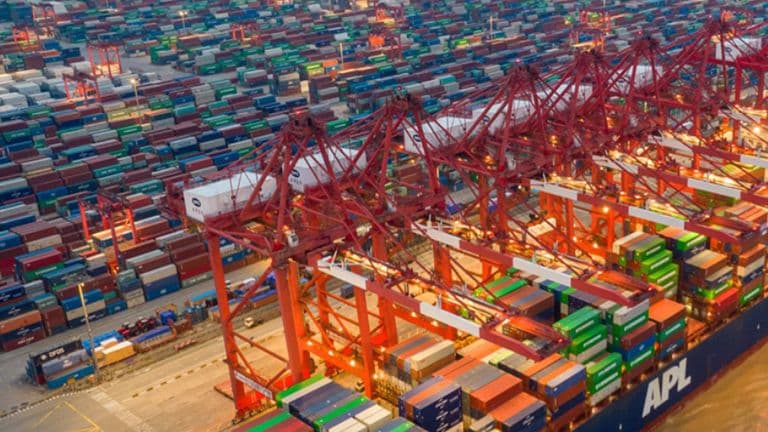
You have two main options. Roll-on/roll-off (RoRo) ships carry cars driven on board and suit large volumes. Containers suit smaller volumes: a 40ft container usually holds 2 to 4 cars depending on size and whether loading racks are used. Electric and hybrid cars ship as dangerous goods because of their batteries, so they need a permit, special packing and documents, and some carriers or ports may refuse them or add charges. Confirm the port of loading, the carrier, the battery documents and the transit time to the destination port with your freight forwarder in advance.
For a wider framework to protect your money on every import deal, see risk management when importing from China.
Common mistakes when importing cars from China
- Choosing the exporter on price alone: the lowest offer often comes from a broker who does not own the cars.
- Ignoring after-sales service: buy brands with a dealer or a clear spare-parts plan in your country, or build a parts stock from the start.
- Buying cars built to Chinese-market specifications without modification: software, language, maps and air conditioning may not suit the Gulf.
- Confusing new with pre-registered: some cars are registered in China and then exported as new, which can void the manufacturer's warranty.
- Paying into a personal account or an account in a different company's name.
For the full process from first enquiry to delivery, see our step-by-step guide to importing from China.
What to do this week
- Pick two or three brands from the large, stable groups and check that they have a dealer or spare parts in your country.
- Ask your national standards authority for the conformity requirements for imported cars in the category you want.
- Ask every exporter on your list for its business licence and export licence, and drop any that hesitate.
- Arrange an independent inspection of your first shipment before you pay the balance.
In the Chinese car market, knowledge and transparency are the strongest tools you have. If you want a team to inspect the cars at the warehouse before shipment, HiGreenPanda provides quality inspection from inside China.
本文解答的问题
Why are Chinese cars so low-priced?
Because production capacity exceeds domestic demand, there is a price war among a large number of manufacturers, and exporters recover VAT at 13% on export. Some companies sell at cost or below and rely on the rebate as their profit.
Is it safe to import cars from China?
It can be, if you deal with a real exporter that has its own premises, warehouses and an export licence in its own name, and you inspect the cars before shipment. The biggest risks come from brokers trading on other companies' licences, and from brands that may disappear and leave the car without spare parts.
How do I verify a Chinese car export company?
Ask for the business licence and check the name and unified social credit code on the National Enterprise Credit Information Publicity System. Visit the office and warehouse, and make sure the company name on the contract, invoice and bank account matches the licence.
Is China the world's largest car exporter?
Yes. In 2023 China became the world's largest car exporter, with exports of almost 5 million vehicles according to the China Association of Automobile Manufacturers. This followed more than a decade of state support for the electric vehicle industry.
Are Chinese cars suitable for the Gulf climate?
Many are built in versions tailored to the Middle East, but not all. Make sure the car meets Gulf specifications and your national standards authority's requirements, that the air conditioning and battery are designed for high heat, and that the software supports Arabic.
HiGreen Panda Marketing