Importing from China
Belt and Road Initiative: What It Means for Your Supply Chain
China's Belt and Road Initiative has added ports, railways and industrial zones across Asia, Africa and the Middle East. Here is what it changes for importers and how to use it in your shipping plans.
作者:萨米·哈吉里阅读约需 8 分钟
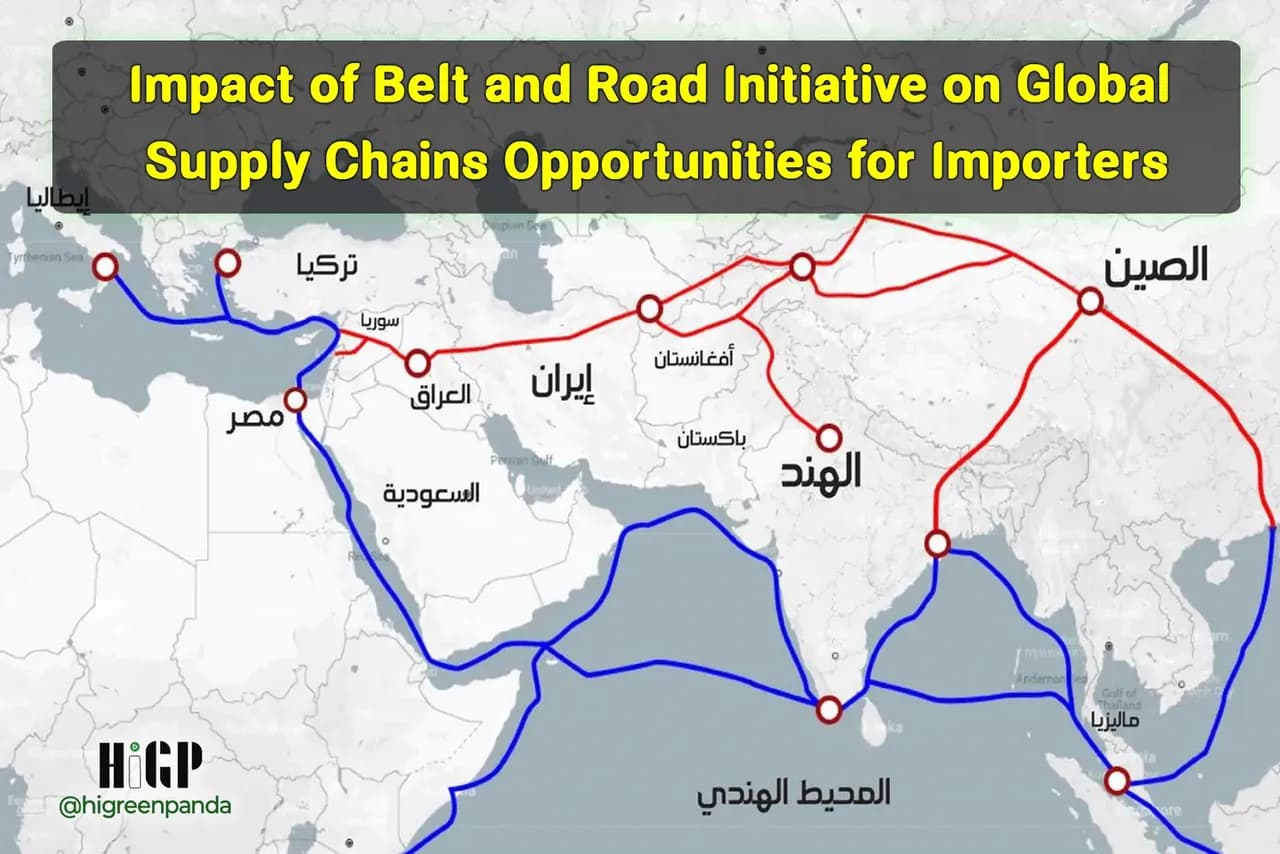
You ship from China every month, and you keep hearing that new ports, railways and industrial zones are changing trade routes. The Belt and Road Initiative is the programme behind many of those changes, and it has been reshaping global supply chains since China launched it in 2013. By the end of this guide you will know what the initiative is, which routes and zones matter to an importer in the Gulf or the wider Arab region, and how to judge whether a new route suits your cargo.
What the Belt and Road Initiative is and how big it has become
The initiative is widely described as one of the most ambitious infrastructure programmes in history. It has two parts. The Silk Road Economic Belt covers land routes: railways, highways and pipelines through Central Asia towards Europe and the Middle East. The 21st Century Maritime Silk Road covers sea routes and the ports that serve them, from Southeast Asia through the Indian Ocean to the Gulf, the Red Sea and the Mediterranean.
Around 147 countries, representing about two-thirds of the world's population and roughly 40% of global GDP, have signed projects or expressed interest in taking part. China has spent in the region of $1 trillion so far, and some estimates put total spending over the life of the initiative as high as $8 trillion. Figures vary by source, because the initiative has no single budget and many projects are financed by loans rather than grants.
How the initiative changes trade flows
World Bank research estimated that the initiative could raise trade flows between participating countries by up to 4.1%. The effect is larger for time-sensitive goods such as timber and plant products, where faster transport and shorter waits at borders make the biggest difference to value. For the latest figures, see our analysis of China imports in 2025.
For you, the practical effects are more carriers and terminals on some routes, new inland routes as alternatives to sea freight, and factories opening in countries outside China. None of this replaces the standard sea route from South China to Jebel Ali, Dammam or Aden, but it gives you more options when that route is congested or disrupted. Much of that South China cargo leaves from the Greater Bay Area around Qianhai and Shenzhen.
Think of the initiative as background infrastructure rather than a service you buy. You do not book a Belt and Road shipment; you book a carrier, a rail operator or a forwarder that happens to use these ports and corridors. The questions that matter stay the same: how long, how much, how reliable, and what paperwork each border needs. On the Chinese side, our guide to China customs clearance lists the documents.
The routes and hubs that matter to Arab importers
Ports on the Maritime Silk Road
Chinese companies have built, expanded or taken stakes in ports along the main trade lanes. Examples include the COSCO container terminal at Khalifa Port in Abu Dhabi, the Doraleh multipurpose port in Djibouti, Gwadar in Pakistan and Piraeus in Greece. More terminal capacity and more direct services can mean shorter waits and more choice of carrier, but schedules still depend on the shipping line, not the port owner.
Rail and land corridors
China–Europe rail freight typically takes about 12 to 20 days, compared with 30 to 45 days by sea to Northern Europe, at a cost between sea and air. The China–Laos railway and the land–sea corridor linking Chongqing to the ports of the Beibu Gulf connect inland China with Southeast Asia. These routes matter most if you also sell into Europe or Central Asia, or if your supplier is in western China, far from the coastal ports.
Industrial and economic zones
The initiative includes hundreds of special economic zones designed to create jobs and attract manufacturing, such as the China–Egypt TEDA Suez Economic and Trade Cooperation Zone near Ain Sokhna. Chinese-owned factories in these zones can supply goods closer to Arab markets. Check the certificate of origin carefully: a product made in Egypt may qualify for different duty treatment from one made in China under your country's trade agreements.
Opportunities for importers
- Improved connectivity: a wider network of railways, pipelines and highways gives you alternatives if one route is blocked.
- Simpler border crossings: customs cooperation between participating countries has reduced some logistical barriers, especially on land routes. China also joined the TIR system for international road transport, which lets sealed trucks cross borders with fewer inspections.
- More supplier locations: factories in special economic zones outside China can shorten transit to your market.
- More competition among carriers and terminals, which can improve schedules on some lanes.
- Faster options for time-sensitive goods, where rail or sea–rail combinations can sit between sea and air on both cost and speed.
Before you change routes, compare the full landed cost, not just the freight rate. Our article on strategies to reduce import costs from China shows how freight, duty, storage and inventory costs add up. Your Incoterm decides which of these costs you pay; see Incoterms for importing from China.
How to test a new route for your cargo
A new corridor is only useful if it is reliable for your product and your destination. Test it before you move a large share of volume.
- List your current routes with origin city, port of loading, destination port, transit time, freight cost per 20ft or 40ft container and average delay.
- Ask your forwarder which alternative routes serve your origin and destination, including rail, sea–rail and transhipment via newer ports.
- Request door-to-door quotes that include handling at each transfer point, customs clearance and inland delivery.
- Check documentary requirements at every border on the route, including whether a transit declaration or certificate of origin is needed.
- Ship a trial consignment of 1 or 2 containers and record the actual transit time and any extra charges.
- Compare the trial with your usual route on cost, time, damage and paperwork before you switch more volume.
If you are still setting up your import process, start with our step-by-step guide to importing from China so your documents and payment terms are in place before you experiment with routes.
Risks and limits to keep in view
The initiative creates options, but it does not remove supply chain risk. Some risks are new.
- Geopolitical risk: routes that cross several countries are exposed to disputes, sanctions and conflict. Red Sea disruptions since late 2023 showed how quickly carriers reroute and how freight rates respond.
- Debt and project risk: some projects have been delayed, renegotiated or scaled back when host countries struggled to repay loans.
- Capacity risk: a new port or rail line may have few services at first, so one cancelled sailing or train can delay you by a week or more.
- Compliance risk: goods transiting several countries face more paperwork, and a single error can hold a shipment at a border.
- Origin risk: goods made in a Chinese-owned zone abroad must still meet the rules of origin and standards of your market.
Our article on risk management strategies when importing from China covers how to spread these risks across suppliers, routes and payment terms.
Common mistakes importers make with new trade routes
- Assuming a new port or railway means lower costs, without comparing door-to-door quotes.
- Switching all volume to an untested route after one good shipment.
- Ignoring transhipment and handling fees at each transfer point.
- Buying from a factory in an economic zone without checking the certificate of origin and duty treatment in your country.
- Relying on headline statistics about the initiative instead of actual schedules and transit times for your lane.
- Forgetting that product standards and conformity certificates for your market still apply, wherever the goods are made. Our compliance checklist for importing from China lists what to check.
What to do this week
- Write down your three main shipping lanes with current transit times and costs.
- Ask your forwarder for one alternative route per lane and a door-to-door quote for each.
- Check whether any of your products could be sourced from a Chinese-owned factory in an economic zone closer to your market, and what the certificate of origin would say.
- Identify which shipments are most time-sensitive and could justify rail or sea–rail freight.
- Plan one trial shipment on the most promising alternative within the next quarter.
HiGreenPanda's shipping and freight team in Shenzhen and Shanghai can quote alternative routes from your supplier's door and handle export documents for a trial shipment.
本文解答的问题
What is the Belt and Road Initiative?
It is a Chinese programme launched in 2013 to build and finance infrastructure along land and sea trade routes. It covers railways, highways, pipelines, ports and industrial zones. Around 147 countries have signed projects or expressed interest in taking part.
How does the Belt and Road Initiative affect global supply chains?
It adds new transport routes, port capacity and manufacturing zones, which gives shippers more options. World Bank research estimated it could raise trade between participating countries by up to 4.1%, with larger effects for time-sensitive goods. It also adds new geopolitical and capacity risks.
Does the Belt and Road Initiative make shipping from China to the Gulf faster?
For most Gulf importers, sea freight from South China remains the main route, and transit times depend mainly on the shipping line. New terminals such as COSCO's at Khalifa Port add capacity and carrier choice. Always compare actual schedules and door-to-door quotes rather than assuming a route is faster.
Does rail freight from China cost less than sea freight?
No, rail freight usually costs more than sea freight and less than air. On China–Europe routes it typically takes about 12 to 20 days, compared with 30 to 45 by sea. It suits goods where speed is worth the extra cost.
Can I buy Chinese-made goods from factories outside China?
Yes, many Chinese companies operate factories in special economic zones abroad, including in Egypt. The goods take the origin of the country where they are substantially made, which can change duty treatment. Check the certificate of origin and your customs authority's rules before ordering.
HiGreen Panda Marketing