Industries and sectors
China's Mining Industry: Questions and Answers for Traders
What does China's mining industry produce, how is it regulated, and how do its price swings and export rules affect you as a buyer of steel, copper, batteries or solar equipment? Clear answers and practical steps.
作者:萨米·哈吉里阅读约需 9 分钟
If you buy steel, aluminium profiles, copper cable, batteries or solar equipment from China, your prices and delivery times depend on what happens in China's mining industry. A mine closure, a new export rule or a swing in iron ore prices can change a quotation within days. This guide answers the most common questions about the sector and, for each, explains what it means for you as an importer or investor. By the end you will know which materials to watch, which risks to plan for and what to check with suppliers.
What are the main parts of China's mining sector?
China mines and processes almost every major mineral, but five groups matter most for trade.
Coal
Coal still supplies more than half of China's primary energy. Its share is falling slowly as solar, wind and hydropower grow, but it remains the backbone of power supply and of steel production. When coal supply tightens, electricity rationing can slow factories, which is one reason delivery dates sometimes slip. Coal-fired power also matters for aluminium, because smelting uses large amounts of electricity; China caps its total aluminium smelting capacity at around 45 million tonnes a year, which limits how fast supply can respond to demand.
Iron ore and steel
China produces more than half of the world's crude steel but imports most of the iron ore it needs, mainly from Australia and Brazil. That dependence makes Chinese steel prices sensitive to seaborne ore prices. For construction and fabrication buyers, it is the single biggest driver of steel quotations. Our article on China's construction industry explains how domestic building demand adds to this.
Copper and aluminium
Demand for both is driven by infrastructure and electricity networks. China is the largest producer of aluminium and the largest consumer of copper, and it relies heavily on imported copper concentrate. Cables, transformers, air-conditioning parts and aluminium profiles all follow these metal prices.
Rare earth elements
China leads the world in rare earth mining and, by a wider margin, in processing. Rare earths go into magnets for electric motors, wind turbines and electronics. Since 2023 China has placed export licensing requirements on several critical minerals and related products, including gallium, germanium, graphite, antimony and some rare earths. The list changes, so check the latest announcements from the Ministry of Commerce (MOFCOM) and ask your supplier whether an export licence is needed.
Battery metals
Lithium, nickel and cobalt are growing fastest because of electric vehicles and energy storage. China refines a large share of the world's battery materials, much of it from ore mined abroad, and it dominates cell manufacturing. See our guide to China's green energy sector for the downstream side.
Environment, safety and governance
What are the main environmental challenges?
The main problems are the treatment of tailings and waste, acid drainage, and dust. The sector is also working to reduce emission intensity through cleaner energy and more efficient consumption. Stricter enforcement can close non-compliant mines and smelters quickly, which tightens supply.
How are safety and compliance handled?
Regulators carry out periodic inspections and close high-risk mines, raise safety standards for deep mines, and push for better disclosure and governance. After serious accidents, whole regions can halt production for checks, so a single incident can affect supply of a mineral for weeks. For you, this is a good reason to keep a second approved supplier for any critical metal input.
Which rules and frameworks apply?
The direction is stricter environmental regulation, ESG disclosure standards for listed companies, and state support for research into clean mining and urban recycling. If you are choosing suppliers partly on environmental grounds, our guide to choosing environmentally friendly suppliers sets out what to ask.
How are local communities managed?
The expected approach is early consultation, fair compensation, training and alternative employment programmes, and regular, transparent public monitoring of environmental impact.
Which indicators measure performance?
- Accident rate per 1,000 workers
- Emission intensity, measured in tonnes of CO2 per tonne of ore
- Percentage of waste that is treated
- Metal recovery rate in processing
If you invest in or partner with a mining or processing company, ask for these four figures for the past three years. A company that cannot produce them is a governance risk.
How do market swings affect you, and how can you protect yourself?
The sector is highly sensitive to commodity prices. China uses strategic stockpiling and futures hedging to manage the risk, particularly because it depends on imported iron ore and copper. Chinese futures markets are active: iron ore on the Dalian Commodity Exchange, copper and aluminium on the Shanghai Futures Exchange, and lithium carbonate on the Guangzhou Futures Exchange. Chinese suppliers watch these prices daily and often quote with short validity periods.
As a buyer, you cannot control these swings, but you can reduce their effect on your margin. Remember too that Chinese exporters usually quote metal-heavy goods in USD while their costs are in CNY, so a large exchange-rate move can also prompt a price revision.
- Ask suppliers to break down quotations into metal content and processing cost, so you can see what a price change really affects.
- Agree a price-adjustment clause linked to a public index, such as the Shanghai Futures Exchange or London Metal Exchange price, with a threshold (for example a move of more than 5%) before prices change.
- Fix quotation validity in writing, typically 7 to 15 days for metal-heavy products, and pay the deposit within that window.
- Split large orders into staged deliveries so you do not buy your whole annual volume at one price.
- For large, regular volumes, talk to your bank about hedging, and get professional advice before using futures yourself.
- Check export licence status for any critical mineral product before you pay, and build extra lead time into the contract if a licence is required.
Technology and where the sector is heading
Innovation stands out in automated smart mines, Internet of Things sensors, autonomous haul vehicles and digital twins used for predictive maintenance and schedule optimisation. Our article on how China leads in robots and AI covers the same trend in factories.
Over the next 3 to 5 years, expect deeper digitisation of mines, more low-carbon projects, expansion in recycling, and more international activity by Chinese companies along electric vehicle battery supply chains. The energy transition drives rising demand for copper, lithium and nickel from electric vehicles and renewable energy, with a gradual decline in coal's role.
Strategic trends: consolidation, local value and recycling
Three trends shape the sector. First, small operators are being merged into larger groups, which improves safety and control but reduces the number of independent sellers. Second, China is adding more value at home, especially in rare earths and batteries, by processing and manufacturing rather than exporting raw material. Third, Chinese companies invest in mines abroad to secure supply.
What is the status of urban mining and recycling?
Urban mining means recovering metals from electronic waste and industrial residues. Initiatives are growing, with government support to expand capacity and to count recycling towards emission reduction targets. For battery recycling, the Ministry of Industry and Information Technology (MIIT) publishes a list of companies that meet its industry standards; check whether a potential partner is on it.
What opportunities exist for international partners?
Demand is strongest for low-emission equipment, clean processing technologies, safety solutions, recycling partnerships and hedging services. For Gulf companies the opportunity also runs the other way: Saudi Arabia's push to develop mining under Vision 2030, and wider Gulf investment in metals and processing, create demand for Chinese mining machinery, processing equipment and technical services.
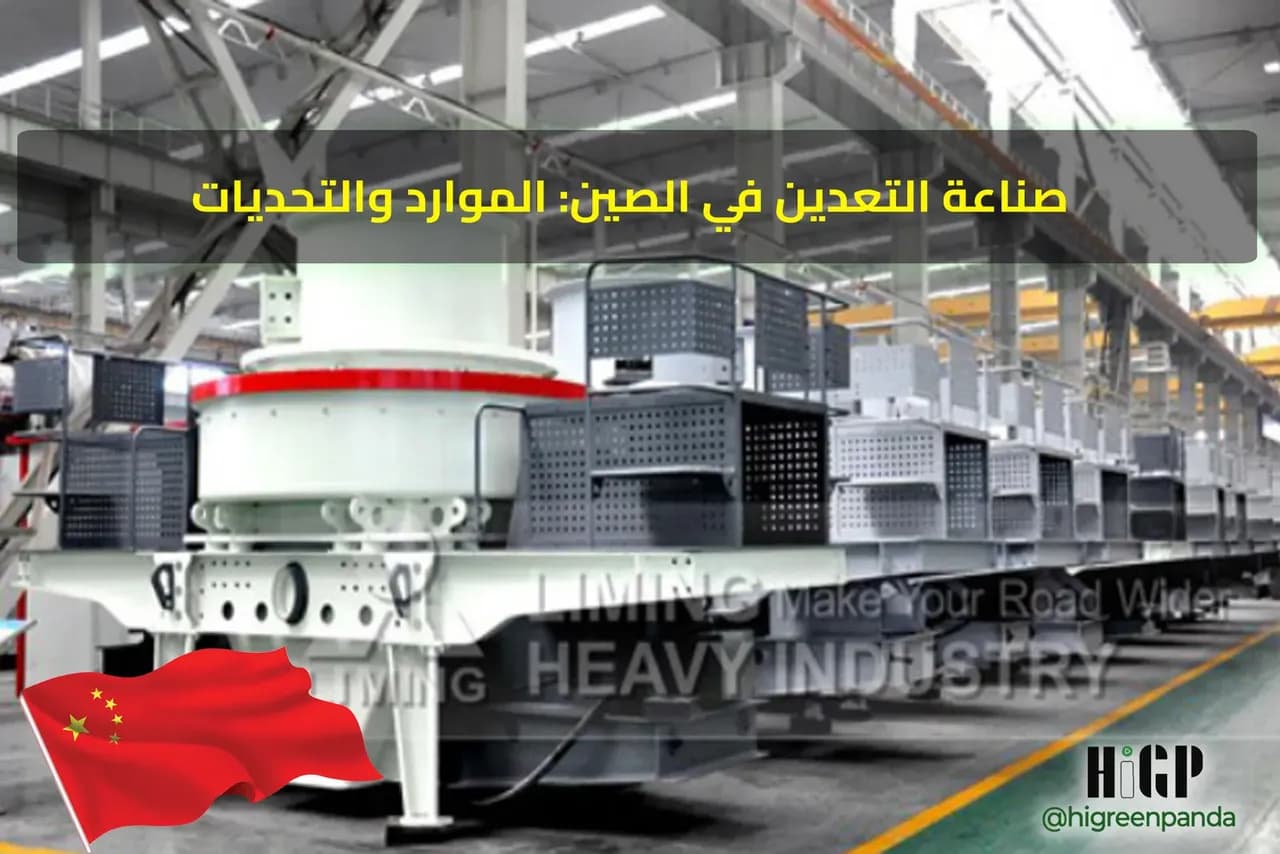
Chinese mining machinery, such as excavators, crushers, conveyors and flotation equipment, is widely used in Africa, Central Asia and the Middle East. When you buy, compare the total cost over the life of the machine rather than the purchase price alone: power or fuel consumption, wear parts, service visits and resale value. Ask for references from customers in similar climates, because heat and dust in the Gulf shorten the life of seals, filters and electronics.
Before you buy metal products or mining equipment, work through this checklist:
- Mill test certificate (for example EN 10204 type 3.1) showing grade and chemical composition
- Independent laboratory test for grade, purity or coating thickness on a sample from your batch
- Correct HS code and whether the item needs an export licence from China
- Certificate of origin and any conformity certificate your country requires
- Price-adjustment clause and quotation validity written into the contract
- Pre-shipment inspection of quantity, markings and packing before the balance is paid
- For equipment: spare parts availability, local service support and operator training
Common mistakes importers make
- Accepting a quotation without checking how much of the price is metal content
- Paying a deposit after the quotation has expired and then facing a price increase
- Assuming every mineral product can be exported freely, without checking licence rules
- Relying on the supplier's own test report instead of an independent one
- Buying a full year's volume at one price during a market peak
- Choosing a recycling or processing partner without checking its environmental compliance
What to do this week
List the metal-heavy products you buy from China and the metal each one depends on. For your largest order, ask the supplier for a cost breakdown, add a price-adjustment clause and confirm whether any export licence applies. Then book an independent test or inspection for the next shipment. HiGreenPanda can find and vet suppliers on the ground through our product sourcing service.
本文解答的问题
What minerals does China mine the most?
Coal is the largest by volume and still supplies more than half of China's primary energy. China is also a major producer of rare earths, aluminium and steel, and it is growing in battery materials such as lithium. It imports most of its iron ore and a large share of its copper concentrate.
Does China control the rare earth market?
China leads the world in rare earth mining and holds an even larger share of processing. Since 2023 it has added export licensing requirements for several critical minerals and some rare earths. Check the latest MOFCOM announcements and ask your supplier whether a licence is needed.
Why do Chinese steel and copper prices change so quickly?
The sector is highly sensitive to commodity prices, and China depends on imported iron ore and copper. Suppliers track futures prices on the Dalian and Shanghai exchanges daily. That is why quotations for metal-heavy products often have validity periods of only 7 to 15 days.
What is urban mining in China?
Urban mining is the recovery of metals from electronic waste and industrial residues. It is growing with government support and counts towards China's emission reduction targets. For battery recycling, check whether a partner is on MIIT's list of companies meeting its industry standards.
What opportunities are there for foreign companies in China's mining sector?
The strongest openings are in low-emission equipment, clean processing technology, safety solutions, recycling partnerships and hedging services. Gulf companies developing their own mining and metals projects can also source Chinese machinery, processing equipment and technical services.
HiGreen Panda Marketing