Economy and the Belt and Road
The Belt and Road Initiative: What It Means for Gulf Importers
China presents the Belt and Road Initiative as the backbone of a global community with a shared future. Here is its history, its principles and what it changes for a Gulf or Arab importer in practice.
作者:萨米·哈吉里阅读约需 16 分钟
You hear the Belt and Road Initiative mentioned in every speech about China and the Arab world, but it is hard to tell what it changes for a business that imports goods. It is China's largest foreign policy programme, launched in 2013 and now covering more than 150 countries. This guide explains where the idea comes from, how China describes its purpose and principles, and what it means in practice for your shipping routes, suppliers, payments and risks.
What the Belt and Road Initiative is
In March 2013, President Xi Jinping put forward the vision of a global community with a shared future. In September and October of the same year he proposed two linked initiatives: the Silk Road Economic Belt and the 21st Century Maritime Silk Road. Together they became the Belt and Road Initiative, or BRI.
The Belt and the Road
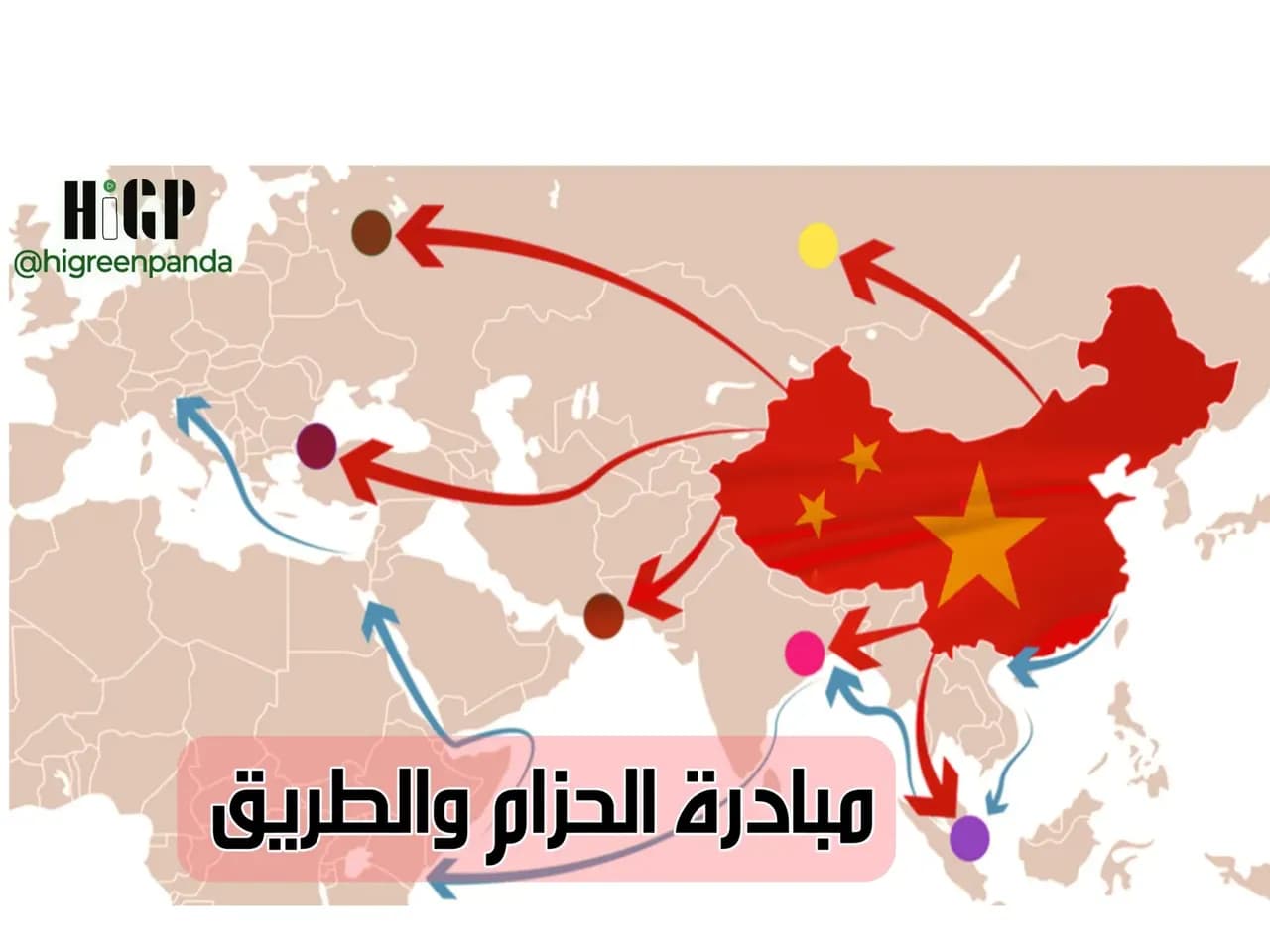
- The Silk Road Economic Belt is the overland part: rail, road, pipelines and border crossings linking China with Central Asia, Russia, the Middle East and Europe.
- The 21st Century Maritime Silk Road is the sea part: ports, shipping lanes and industrial zones linking China's coast with South-East Asia, South Asia, the Gulf, East Africa and the Mediterranean.
The name is confusing, because the Road is at sea and the Belt is on land. For a Gulf importer the maritime part matters most, since almost everything you buy from China arrives by container ship.
A community with a shared future
China presents the BRI as the practical platform for its idea of a global community with a shared future. In its own description, the initiative has moved over its first 10 years from ideas to action, from a general framework to tangible projects, and from a Chinese proposal to an international undertaking. Beijing describes it as a public good that China launched but that belongs to the world. More than 150 countries have signed cooperation documents with China under the initiative.
You do not have to accept every part of that framing to use what the initiative has built. The rest of this guide separates what China says the BRI is for from what it means on the ground for your trade. For a shorter overview of the programme itself, see our guide to China's Belt and Road Initiative.
Why China draws on the ancient Silk Roads
China frames the BRI as a modern version of the Silk Roads, which it sees as two of the great achievements of human civilisation. The history matters because it explains the language used in official meetings and why Arab countries feature so prominently.
The overland Silk Road
More than 2000 years ago, travellers crossed plains and deserts to build the overland Silk Road, which connected Asia, Europe and Africa. Around 140 BC, during the Han dynasty, the royal envoy Zhang Qian travelled west from Chang'an, today's Xi'an in Shaanxi province, and opened a land route between East and West. Over the following centuries, under the Tang, Song and Yuan dynasties, trade flourished by land and by sea.
The maritime Silk Road
More than 1000 years after the land route opened, sailors opened the maritime Silk Road, which carried goods between China's southern ports and the Indian Ocean. Arab and Persian merchants were central to this trade, and communities of Arab traders lived in Chinese ports such as Guangzhou and Quanzhou. In the early 15th century, the Ming dynasty navigator Zheng He made 7 voyages to the Western Seas and strengthened trade along these routes.
The Silk Road spirit
For thousands of years these routes linked the valleys of the Nile, Tigris, Euphrates, Indus, Ganges, Yellow River and Yangtze. They connected the birthplaces of Egyptian, Babylonian, Indian and Chinese civilisations, lands of Buddhists, Christians and Muslims, and peoples of many nationalities. China summarises what it calls the Silk Road spirit as peace and cooperation, openness and inclusiveness, mutual learning and mutual benefit. It links this to long-standing Chinese ideals: harmony among nations, good neighbourliness, and helping others succeed while pursuing your own success.
When a Chinese official or business partner mentions the Silk Road at a meeting, this is the reference. It signals that China sees the Arab world as a historic trading partner, not a new one.
The problems China says the BRI addresses
China's official case for the initiative rests on three arguments: development gaps, the future of globalisation and shared global challenges.
Development gaps
China argues that development is the key to solving all problems, but that globalisation dominated by a few countries has not produced development for all. In its view it has widened the gap between rich and poor, between developed and developing countries, and within developed countries. Many developing countries gained little, and some lost the capacity to develop independently. China also criticises unilateralism, protectionism and hegemony, which it says threaten the world economy with recession.
Making globalisation more open and inclusive
China holds that economic globalisation is irreversible and that countries cannot return to isolation, but that it must become more open, inclusive, balanced and beneficial to all. China presents itself as both a beneficiary of globalisation and a contributor to it: it grew rapidly through reform and opening-up, and it offers its own path to modernisation as an option for other developing countries. It states that the BRI aligns with the UN 2030 Agenda for Sustainable Development in concept, measures and goals, and that it shares China's development opportunities with other countries through higher-standard openness.
Shared global challenges
Looking forward, China points to a world that is more multipolar, more interconnected and more dependent on information. It lists growing deficits in peace, development, security and governance, and a range of threats: regional conflicts, arms races, food security, terrorism, cyber attacks, climate change, energy crises, major infectious diseases and risks from artificial intelligence. Its answer is the community with a shared future, which it describes as an open, inclusive, clean and beautiful world with lasting peace, universal security and common prosperity. The BRI is presented as the practical means of building it, open to countries at every stage of development and across differences in ideology and social system.
Two of these themes, food security and energy, are directly relevant to Gulf trade. The Gulf imports most of its food and exports energy, and China is a large buyer of that energy and a growing supplier of farm machinery, greenhouse equipment, cold-chain systems and solar technology. When China talks about shared challenges in these areas, expect more financing, more joint projects and more Chinese suppliers competing for those contracts in your market. If you trade in these sectors, the policy language translates directly into sales leads and competitors.
The three principles and what they mean for business
The BRI rests on three principles: extensive consultation, joint contribution and shared benefits. They sound abstract, but each has a practical reading for a company.
Extensive consultation
China states that the BRI is not a unilateral effort but a cooperative one. All countries, whatever their size or wealth, take part as equals, participation is voluntary, and there are no political or economic preconditions. Decisions are meant to respect each country's level of development, economic structure, legal system and culture, and to build consensus through bilateral and multilateral dialogue.
For you, this means BRI projects are negotiated government to government. The terms of any port, zone or trade arrangement are set in bilateral agreements between China and your country. Read those agreements, or ask your chamber of commerce for a summary, rather than assuming one arrangement applies everywhere.
Joint contribution
China says the BRI is neither an aid programme nor a geopolitical tool, but a joint effort for common development. It is meant to align with existing regional mechanisms rather than replace them, and to match each country's development strategy with its comparative advantages. Countries and companies can join through bilateral cooperation, multilateral cooperation or third-party market cooperation, where a Chinese firm and a firm from another country work together in a third market.
The principle gives companies the central role. Governments build platforms, set up mechanisms and provide policy guidance; enterprises do the business, and projects are meant to run on market terms. China explains its leading role by its economic scale, its market size, its experience building infrastructure, its ability to produce low-cost, high-quality and high-performance equipment, and its strengths in innovation and technology.
Third-party market cooperation is the part most open to Arab companies. A Chinese contractor building a port, power plant or housing project in your region needs local distributors, subcontractors, logistics partners and suppliers of materials it does not ship from China. If you already import building materials, electrical goods or equipment, these contractors are potential customers as well as competitors. Register with their local procurement offices and ask how they qualify vendors.
Shared benefits
The third principle is that all participants should be contributors and beneficiaries, with economic integration and interconnected development. In practice, the benefits you can measure are shorter routes, more shipping capacity, industrial zones with Chinese tenants near you, and more ways to pay and be paid.
Benefits are not spread evenly. They depend on which projects your country has signed, how far they have progressed, and whether they touch your product and route. A trader in Abu Dhabi who ships through Khalifa Port sees a different effect from a trader in Sanaa who relies on transhipment. Judge the initiative by what it changes on your own lane, not by the headline figures.
What the Belt and Road means for Gulf and Arab importers
Here is where the initiative touches your business directly. Treat the examples as starting points to check, because project status changes.
Ports and shipping
Chinese companies have invested in port terminals along the maritime route, including a COSCO Shipping terminal at Khalifa Port in Abu Dhabi, the Piraeus port in Greece and Gwadar in Pakistan. More terminals and more direct services mean more sailings between Chinese ports and the Gulf. Sea transit from Shanghai or Shenzhen to Jebel Ali typically takes about 15 to 25 days; the port pair, transhipment and season move that figure. For the overland Belt, freight trains now run regularly between China and Europe, which matters if you also trade with Europe or Central Asia.
Industrial zones and investment
Several Arab countries host Chinese industrial zones linked to the initiative, such as the China-Egypt TEDA Suez zone at Ain Sokhna and the China-UAE industrial capacity cooperation zone in Abu Dhabi's Khalifa Economic Zones. Chinese manufacturers in these zones produce closer to you, which can cut freight and, in some cases, change the rules of origin that apply to your goods. Ask the zone authority which companies operate there and in which sectors. If you plan to buy from a zone factory, ask your customs broker how its goods are classified for origin: goods substantially made in the zone may be treated differently from goods simply relabelled there, and the duty and documents follow from that.
Finance and payments
The BRI created or expanded financing channels, including the Silk Road Fund and the Asian Infrastructure Investment Bank. For a trader the more immediate change is in payments: more banks in the region offer renminbi accounts and settlement, and China's Cross-border Interbank Payment System (CIPS) handles renminbi transfers. Central banks, including the UAE's, are also testing cross-border digital currency settlement with China. Our guide to China and central bank digital currencies explains what is live and what is still a pilot. Before you switch currency, compare the full cost: the bank's conversion spread, transfer fees and the time the money takes to arrive. Some Chinese suppliers offer a small discount for renminbi payment because it saves them conversion; ask, but compare it with your own bank's spread.
Energy and construction projects
Much BRI activity in the Arab world is in energy, construction and telecoms: power plants, solar parks, housing, roads and networks. These projects pull in Chinese equipment and materials, and they create demand for local trading firms that can hold stock, clear customs and deliver to site. If you supply this sector, follow project announcements from your government and the main Chinese contractors, and approach them before tendering starts. Our article on the services trade between China and the world covers the engineering and logistics side.
Trade agreements and tariffs
The BRI is not itself a free trade agreement. It does not cut customs duties on its own. China and the Gulf Cooperation Council have been negotiating a free trade agreement for many years; check its current status with your ministry of commerce or customs authority before you assume any preferential rate. Our article on China and free trade tracks the agreements China has signed, and bilateral trade between China and Arab countries covers the main flows.
How to use the Belt and Road in your own trade
The initiative is large, but you only need the parts that touch your product, route and market. Work through these steps.
- Map your current route. Write down the Chinese port your goods leave from, any transhipment port, your arrival port, transit days and freight cost per 20ft or 40ft container over the last year.
- Check for new services. Ask two or three freight forwarders whether new direct sailings, terminals or rail links on your lane could shorten transit or reduce transhipment.
- Look at nearby zones. Find out whether Chinese manufacturers in your product category operate in an industrial zone in your region. Local production can cut lead times from weeks to days.
- Review your payment options. Ask your bank whether it offers renminbi accounts, what the conversion spread is compared with paying in USD, and how long transfers take.
- Confirm your duty rates. Check your customs authority's tariff schedule for your HS codes and confirm whether any preferential agreement applies. Do not rely on a supplier's word.
- Assess the risks. Consider sanctions exposure, route disruption and political change in transit countries before you commit to a new route or partner.
- Record the result. Keep a one-page note per product line with route, cost, duty and payment method, and update it every 6 months.
Most of these steps take a few hours of emails and calls. The one that takes longest is a trial shipment on a new route, which is worth doing with a single 20ft container before you move your regular volume. Compare the actual door-to-door days and landed cost against your current route, and switch only if the saving holds over at least two shipments.
Checklist before you rely on a BRI project or route
- The project is operating, not only announced or under construction.
- At least two forwarders confirm the service runs on a regular schedule.
- You know the total landed cost, including port charges and inland transport, not just the ocean freight.
- Your bank can process payments on that route without extra compliance delays.
- You have a fallback route if the new one is disrupted.
Common mistakes importers make about the Belt and Road
- Assuming BRI membership means lower duties. It does not. Tariffs depend on trade agreements and your national tariff schedule.
- Treating announcements as operating services. Many projects are signed years before they run. Ask for a sailing schedule or a zone tenant list.
- Choosing a route on freight rate alone. A lower ocean rate can be wiped out by transhipment delays, demurrage or higher inland costs.
- Ignoring geopolitics. Routes that cross conflict zones or sanctioned countries carry risks your insurer and bank will price in. Our guide to assessing geopolitical risks explains how to weigh them.
- Believing a supplier's BRI claims without checking. A factory that says it is a BRI partner may simply be exporting along a BRI route. Verify its licence and track record as you would any supplier.
- Forgetting the paperwork on a new route. A new port or transit country can bring different certificate of origin, inspection or legalisation requirements. Ask your broker before the first shipment, not after it is held at the port.
- Reading the policy language as a business plan. The principles explain China's intent; your decisions still rest on cost, time, quality and risk.
Where the initiative is heading
China describes the BRI as a long-term, cross-border and systematic project for the 21st century, and says its first 10 years were only the first step. It has held Belt and Road Forums in Beijing, most recently in 2023, and says the next phase will be more open and inclusive and will focus on higher-quality cooperation. It links the initiative to three newer proposals: the Global Development Initiative, the Global Security Initiative and the Global Civilization Initiative.
China also acknowledges that the initiative will face new difficulties. For a trader, the practical expectation is more digital trade infrastructure, more green energy projects and more attention to smaller, commercially viable projects. Watch the areas that affect your costs: shipping capacity on your lane, payment channels, and any progress on a China-GCC trade agreement. A short check every 6 months, using the steps in the next section, is enough to keep up without following every announcement.
What to do this week
- Write down your main China route: ports, transit days and cost per container.
- Ask two forwarders whether any new direct service or terminal on that route could save time or money.
- Ask your bank what renminbi payment options it offers and what they cost compared with USD.
- Check your customs authority's tariff for your top 3 HS codes and note any preferential rate.
- List one risk on your route, such as a chokepoint or a sanctioned transit country, and a fallback option.
If you want help comparing routes and freight options from China, HiGreenPanda's shipping and freight team works from Shenzhen and Shanghai.
本文解答的问题
What is the Belt and Road Initiative in simple terms?
It is China's programme, launched in 2013, to build trade and infrastructure links with other countries. The Silk Road Economic Belt covers overland routes and the 21st Century Maritime Silk Road covers sea routes. More than 150 countries have signed cooperation documents with China under it.
When did the Belt and Road Initiative start?
President Xi Jinping proposed the vision of a global community with a shared future in March 2013. In September and October 2013 he proposed the Silk Road Economic Belt and the 21st Century Maritime Silk Road, which together form the initiative.
What are the three principles of the Belt and Road Initiative?
Extensive consultation, joint contribution and shared benefits. China says all countries take part as equals and voluntarily, that enterprises play the central role while governments build platforms, and that every participant should be both a contributor and a beneficiary.
Does the Belt and Road Initiative reduce import duties for Gulf countries?
No. The initiative is not a free trade agreement. Duties depend on your national tariff schedule and any trade agreement in force. China and the GCC have negotiated a free trade agreement for years, so check its current status with your ministry of commerce.
How does the Belt and Road affect shipping from China to the Gulf?
Chinese investment in port terminals, including at Khalifa Port in Abu Dhabi, has added capacity and services on the maritime route. Sea transit from Shanghai or Shenzhen to Jebel Ali usually takes about 15 to 25 days, depending on the port pair, transhipment and season. Ask forwarders which direct services run on your lane.
HiGreen Panda Marketing